Study facts at a glance
Study population: The 1995 report describes 99 completers over 48 weeks: 32 using 0.1% tretinoin, 35 using 0.025%, and 32 using vehicle. The abstract does not give the starting enrollment denominator. Source 1
Clinical comparison: Both concentrations improved overall facial photoaging relative to vehicle. No clinically or statistically significant efficacy difference between the active concentrations was reported, but formal equivalence was not established. Source 1
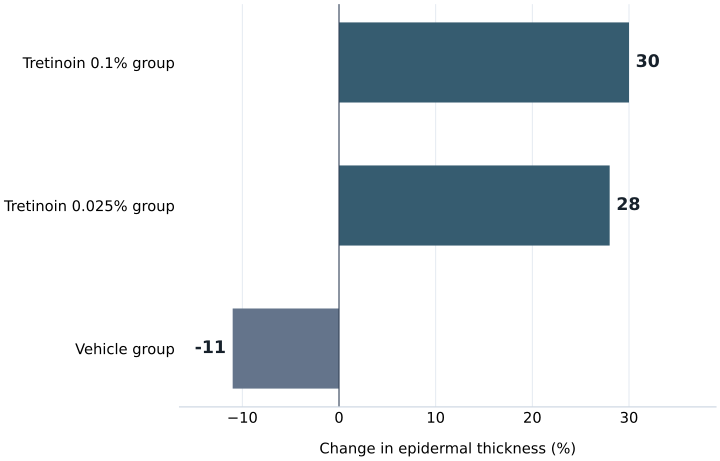
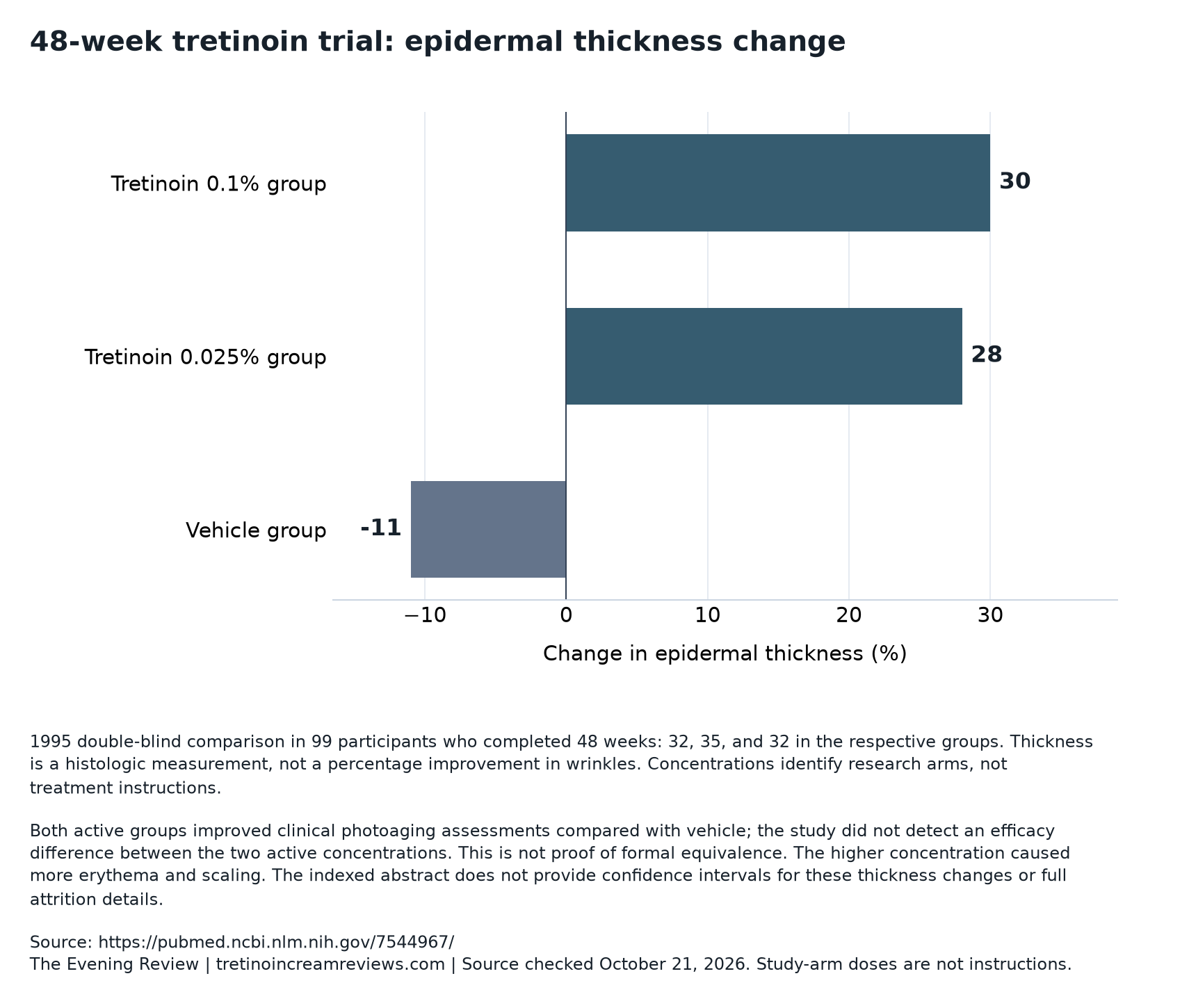
Tissue findings: Epidermal thickness increased 30% and 28% in the active groups, versus an 11% decrease with vehicle. These are tissue measurements, not percentages of wrinkle improvement. Source 1
Treatment burden: Redness and scaling were statistically significantly greater with 0.1% than with 0.025% tretinoin; the abstract does not supply absolute irritation rates. Source 1
Product-specific indication: RENOVA 0.02% labeling addresses mitigation of fine facial wrinkles alongside comprehensive skin care and sunlight avoidance, not universal reversal of skin aging. Source 4
What the 48-week experiment compared
The 1995 study compared topical tretinoin cream at 0.1% and 0.025% with vehicle—the cream base without the active drug—in people with photoaged skin. Photoaging means changes associated with chronic sunlight exposure. Participants used their assigned cream once daily for 48 weeks. These are historical study exposures, not instructions for choosing a concentration or application schedule.
The abstract describes double-blind treatment, meaning treatment identities were concealed during the comparison, and reports 99 people who completed the study. Their distribution was 32, 35, and 32 across the higher-strength, lower-strength, and vehicle arms. It does not provide the original enrollment total, allocation details, or losses before completion. Calling these 99 completers 99 randomized participants would add information the accessible report does not establish.
Investigators assessed overall facial photoaging and examined tissue before and after treatment. Measurements included epidermal structure, vascularity, and selected immune markers. The abstract does not identify a single prespecified primary endpoint or explain the clinical rating scale. That limits reconstruction of the analysis, even though the controlled design offers a much more informative comparison than an isolated consumer photograph.
Read the underlying chart data: download CSV or download the source-labeled chart.
Similar improvement is not proof of equivalence
Both active creams produced statistically significant overall improvement in facial photoaging compared with vehicle. Between 0.1% and 0.025%, however, the investigators reported no clinically or statistically significant efficacy difference. That supports a restrained conclusion: the stronger cream did not demonstrate an additional clinical advantage in this particular comparison over 48 weeks.
It does not prove the concentrations are interchangeable. An equivalence trial needs a defined margin specifying how much difference would count as acceptably small, together with uncertainty estimates showing that the results fall within that margin. The abstract provides neither such a margin nor confidence intervals for the between-strength clinical comparison. A study can fail to detect a difference because the true difference is small, because its estimates are imprecise, or both.
Nor does the report tell readers how many people achieved a personally noticeable change. Without the scoring details, response thresholds, and individual distributions, statistical improvement cannot be translated into a promised cosmetic result. The same endpoint discipline applies when reading tretinoin before-and-after reviews: a selected image does not supply a controlled estimate or reveal how typical that result was.
The biopsy percentages describe tissue, not wrinkle removal
The most striking numbers concern histology, the microscopic examination of tissue. Epidermal thickness increased by 30% with 0.1% tretinoin and 28% with 0.025%, while the vehicle group showed an 11% decrease. Vascularity, measured as dermal endothelial cell area, increased by 100% and 89% in the active groups, compared with a 9% decrease with vehicle.
A 100% increase means the vascularity measurement doubled relative to its baseline value; it does not mean appearance improved by 100%. Likewise, a thicker epidermis is not a numerical measure of wrinkle reduction. The epidermis is the outer skin layer, while the vascularity measurement concerned the underlying dermis. Different tissue compartments and clinical appearance cannot be substituted for one another.
The table keeps these outcomes separate. Although their changes point in similar directions for both active concentrations, the abstract does not supply confidence intervals or enough measurement detail to assess precision independently. The related guide on whether tretinoin thins skin explores why naming the skin layer matters more than applying a single thicker-or-thinner label.
Reported 48-week findings, separated by the outcome actually measured
| Outcome | Active cream findings | Vehicle and interpretation |
|---|---|---|
| Overall facial photoaging | Both concentrations improved; no significant efficacy difference between them was reported | Both outperformed vehicle; no numerical clinical effect size appears in the abstract |
| Epidermal thickness | 0.1%: +30%; 0.025%: +28% | Vehicle: −11%; these are tissue changes, not wrinkle-response percentages |
| Dermal vascularity | 0.1%: +100%; 0.025%: +89% | Vehicle: −9%; measured through endothelial cell area |
| Redness and scaling | Significantly greater with 0.1% than with 0.025% | Absolute rates and confidence intervals are not supplied |
Irritation separated from benefit
The higher concentration caused significantly more erythema, meaning redness, and scaling by several analyses. Because the abstract omits absolute frequencies, severity distributions, and timing, it cannot answer how many additional participants experienced troublesome irritation or how long that irritation lasted. Statistical significance establishes evidence of a difference, not the size of the practical burden.
The scientific importance lies in the separation: clinical and tissue improvements were similar despite different irritation levels. That observation challenges the idea that more visible inflammation necessarily signals more effective treatment. It supports the authors’ interpretation that mechanisms other than irritation dominate the observed response, rather than proving the entire biological pathway.
It would go too far to conclude that irritation is never involved, that no individual needs an irritating exposure to obtain a response, or that absence of peeling predicts success. The experiment compared groups, not personal rules. Investigators also found no significant treatment-versus-vehicle changes in the selected immune markers. Those negative measurements do not establish that every immune process was unchanged.
Why the missing starting denominator matters
A 48-week completion count is informative, but it is not an attrition analysis. If participants who found treatment uncomfortable were more likely to leave, results among those remaining could present a more favorable tolerability picture. That is a possibility to investigate, not evidence that it happened. The abstract supplies neither the number who started nor reasons for withdrawal.
The same missing information affects efficacy interpretation. A comparison limited to people able to continue treatment may answer a different question from the effect of assigning treatment to everyone initially enrolled. The accessible abstract does not describe an intention-to-treat analysis, adherence measurements, or handling of missing observations. Its findings should therefore remain attached to the population and reporting actually described.
Sponsorship and funding are also not identified in these indexed research abstracts. The RENOVA label names Bausch Health as distributor, but that does not establish who funded the 1995 experiment. A complete audit would seek original allocation methods, baseline balance, withdrawal patterns, assessment scales, and funding disclosures rather than infer them from a drug name or publication date.
Source 1 Source 3 Source 2 Source 4
The two-year trial answers a different duration question
The 2005 randomized, placebo-controlled trial studied 204 subjects with moderate to severe facial photodamage. It compared topical tretinoin emollient cream 0.05% with vehicle emollient cream, applied to the entire face once daily for up to two years. Unlike the 1995 comparison, it did not test two active concentrations against each other.
The abstract reports significantly greater improvement with tretinoin in fine and coarse wrinkles, mottled hyperpigmentation, lentigines, sallowness, overall photodamage severity, and investigator-rated clinical response. Lentigines are localized pigmented spots. Numerical changes and confidence intervals are absent, so the report cannot quantify how large those improvements were or establish a concentration-response ranking with the earlier trial.
Histologic evaluation found no increase relative to placebo in keratinocytic or melanocytic atypia, dermal elastosis, or adverse effects on the stratum corneum. These findings concern abnormal cellular appearance, altered elastic tissue, and the outermost skin layer. They are useful measured safety results, not proof of zero long-term harm. The abstract does not provide detailed local irritation or discontinuation rates.
Retinol in elderly arm skin is not a strength comparison
A separate 2007 randomized, double-blind study enrolled 36 elderly adults, averaging 87 years old, from two senior facilities. Study personnel applied 0.4% retinol lotion or vehicle to opposite arms, up to three times weekly for 24 weeks. Retinol is a different ingredient from tretinoin; arm skin with natural aging is also a different setting from facial photoaging.
On a 0-to-9 fine-wrinkling scale, the reported change was −1.64 with retinol, with a 95% confidence interval of −2.06 to −1.22, versus −0.08 with vehicle, with an interval of −0.17 to 0.01. Lower scores indicated less wrinkling. Subtracting the reported mean changes gives a 1.56-point separation favoring retinol, but these individual-arm intervals are not a confidence interval for that calculated difference.
The intention-to-treat analysis carried the last observation forward when later measurements were missing, an approach that assumes the earlier observation can stand in for the missing one. Tiny biopsy subgroups showed increased glycosaminoglycan expression and procollagen staining. Neither those biomarkers nor the clinical findings establish superiority over tretinoin. Our 24-week retinol study analysis examines that distinct experiment in more depth.
Three experiments that should not be treated as one dose-response series
| Study | Population and comparison | What it contributes |
|---|---|---|
| 1995, 48 weeks | Photoaged patients; 99 completers; 0.1% and 0.025% tretinoin creams versus vehicle | Direct active-strength comparison with differing irritation |
| 2005, up to two years | 204 subjects with moderate to severe facial photodamage; 0.05% tretinoin emollient cream versus vehicle | Longer controlled observation, not a comparison between strengths |
| 2007, 24 weeks | 36 elderly adults, mean age 87; 0.4% retinol lotion versus vehicle on opposite arms | Evidence for a different retinoid, body site, and aging context |
RENOVA’s indication belongs to its exact formulation
The current official labeling for RENOVA 0.02% describes an adjunctive role in mitigating fine facial wrinkles in people using comprehensive skin care and sunlight avoidance. It does not claim to eliminate wrinkles, restore younger skin, or reverse photoaging. The label also says this formulation has not demonstrated mitigation of several other signs, including coarse wrinkles, laxity, and mottled hyperpigmentation.
Its clinical program involved 324 evaluable active-treatment patients and 332 evaluable vehicle patients over 24 weeks. Both groups received the accompanying skin-care and sunlight-avoidance program. Two of five trials adequately demonstrated efficacy for fine facial wrinkling. This makes the comparator important: the estimated drug contribution was additional to shared care, not the entire improvement from baseline.
The 0.02% labeled emulsion is not either cream from the 1995 concentration experiment, nor the 0.05% emollient cream studied for two years. Its label states that daily safety and effectiveness beyond 52 weeks have not been established for that product. Findings from another formulation do not erase that product-specific boundary. The cream-versus-serum guide provides context for keeping formulation identity in view.
Real safety findings include substantial local reactions
The RENOVA label reports that almost all of 339 active-treatment patients in double-blind controlled studies experienced at least one local reaction, such as peeling, dryness, burning, stinging, redness, or itching. In 32%, irritation met a combined description: severe, leading to temporary interruption, or leading to use of a mild topical corticosteroid. That is not a 32% permanent-discontinuation rate.
About 7% of RENOVA patients, versus less than 1% of controls, had irritation sufficiently severe to warrant short-term mild topical corticosteroids. About 4% discontinued because of adverse reactions. These figures describe the labeled 0.02% product’s program, not the irritation incidence in the 1995 arms. A lower percentage on the tube does not mean reactions are absent.
The label also addresses heightened sunburn susceptibility, interacting photosensitizing medicines, and pregnancy restrictions. Neither cancer prevention nor treatment of actinic keratoses is established. Separately, the two-year trial’s month-12 increase in a procollagen-synthesis marker is biological evidence, not a cancer, survival, or injury-prevention outcome. Biomarkers help investigate mechanisms; they do not replace clinical endpoints.
What this changes when reviewing a commercial offer
Editorial interpretation: the 1995 comparison weakens the assumption that a higher concentration automatically justifies a stronger cosmetic promise. A defensible product claim needs to identify the formulation, population, duration, and endpoint supporting it. None of these studies automatically validates a provider’s service, compounded preparation, combination formula, oral route, or commercially selected before-and-after gallery.
For a service-level review, the useful next step is documentary rather than predictive. The Nurx review and Dear Brightly review are places to check stated fees, renewal arrangements, and formula documentation—not evidence that either service delivers the products or outcomes studied here. Trial results cannot establish the quality of an unrelated consultation or refill process.
Editorial interpretation: treatment burden belongs in any value discussion, but this evidence does not price it. The studies supply no comparative service costs or contract outcomes. The refill-cost and cancellation guide addresses those separate documents. Scientific efficacy and commercial terms can both matter without pretending that one answers the other.
Source 1 Source 3 Source 2 Source 4
Questions about the evidence
Does this show that 0.025% tretinoin is just as effective as 0.1%?
It shows similar observed clinical improvement in this 48-week comparison, with no clinically or statistically significant efficacy difference reported. That is narrower than proof of equivalence. The abstract lacks a prespecified equivalence margin, between-group confidence intervals, and numerical clinical scores needed to assess how confidently a meaningful difference was excluded.
Should peeling be treated as evidence that tretinoin is working?
Not on the basis of this experiment. The higher concentration produced more redness and scaling without a demonstrated clinical advantage. That separates irritation from the measured benefit at the group level. It does not create an individual rule about how much irritation predicts response, and the abstract does not report a person-by-person correlation.
Did the study show 30% fewer wrinkles?
No. The 30% figure describes increased epidermal thickness in the 0.1% group. The 28% figure describes the same tissue endpoint in the 0.025% group. Neither is a wrinkle-reduction percentage, a cosmetic response rate, or the probability that a person will notice improvement. Clinical appearance was assessed separately.
Does the two-year study establish that every tretinoin cream is suitable indefinitely?
No. It supplies controlled observations for 0.05% tretinoin emollient cream for up to two years, including specified histologic findings. It does not establish indefinite use or identical safety across formulations. RENOVA 0.02% retains its own labeled limitation concerning daily use beyond 52 weeks; the distinct studies should not be merged into a universal safety claim.
Can the elderly-adult retinol trial identify the better ingredient for facial aging?
No. It compared retinol lotion with its vehicle on opposite arms, not retinol with tretinoin on the face. Its fine-wrinkling results support an effect in that specific setting. Differences in ingredient, body site, population, formulation, and duration prevent a valid head-to-head ranking, even though both studies concern vitamin A–related compounds.
What this evidence supports
The strongest conclusion is a specific one: in the reported 48-week comparison, raising tretinoin concentration from 0.025% to 0.1% increased irritation without demonstrating additional clinical photoaging benefit. Similar tissue changes reinforce that observation, but do not prove equivalence or quantify wrinkle improvement. Longer tretinoin research and the elderly-adult retinol experiment add distinct evidence rather than interchangeable confirmation. For reviewing antiaging claims, the practical standard is to keep the exact formulation, comparator, endpoint, and treatment burden attached to every result.
Research access and limitations
The research analysis relies on indexed primary report abstracts, not an examination of all full articles, protocols, or supplements. Full official RENOVA labeling was available. Important missing details include the 1995 starting denominator, attrition, numerical clinical effect sizes, confidence intervals, and funding disclosures. No individual concentration, application schedule, or treatment change is recommended.