Study facts at a glance
Population: 36 adults living in two senior facilities; mean age 87 years. Source 2
Controlled comparison: Study personnel applied topical 0.4% retinol lotion and its vehicle to opposite arms, up to three times weekly for 24 weeks. Source 2
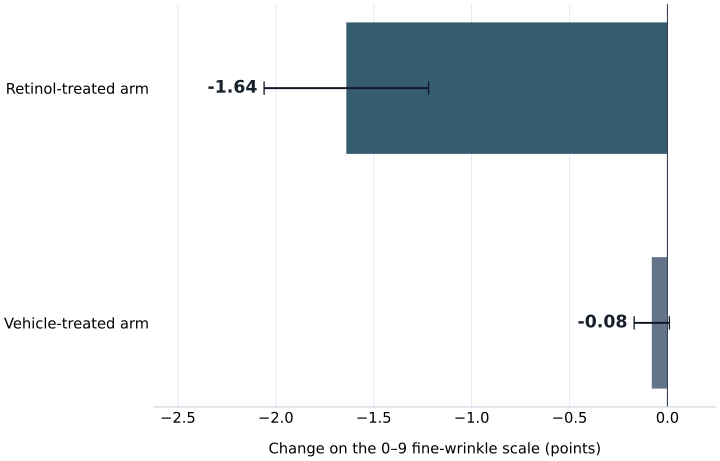
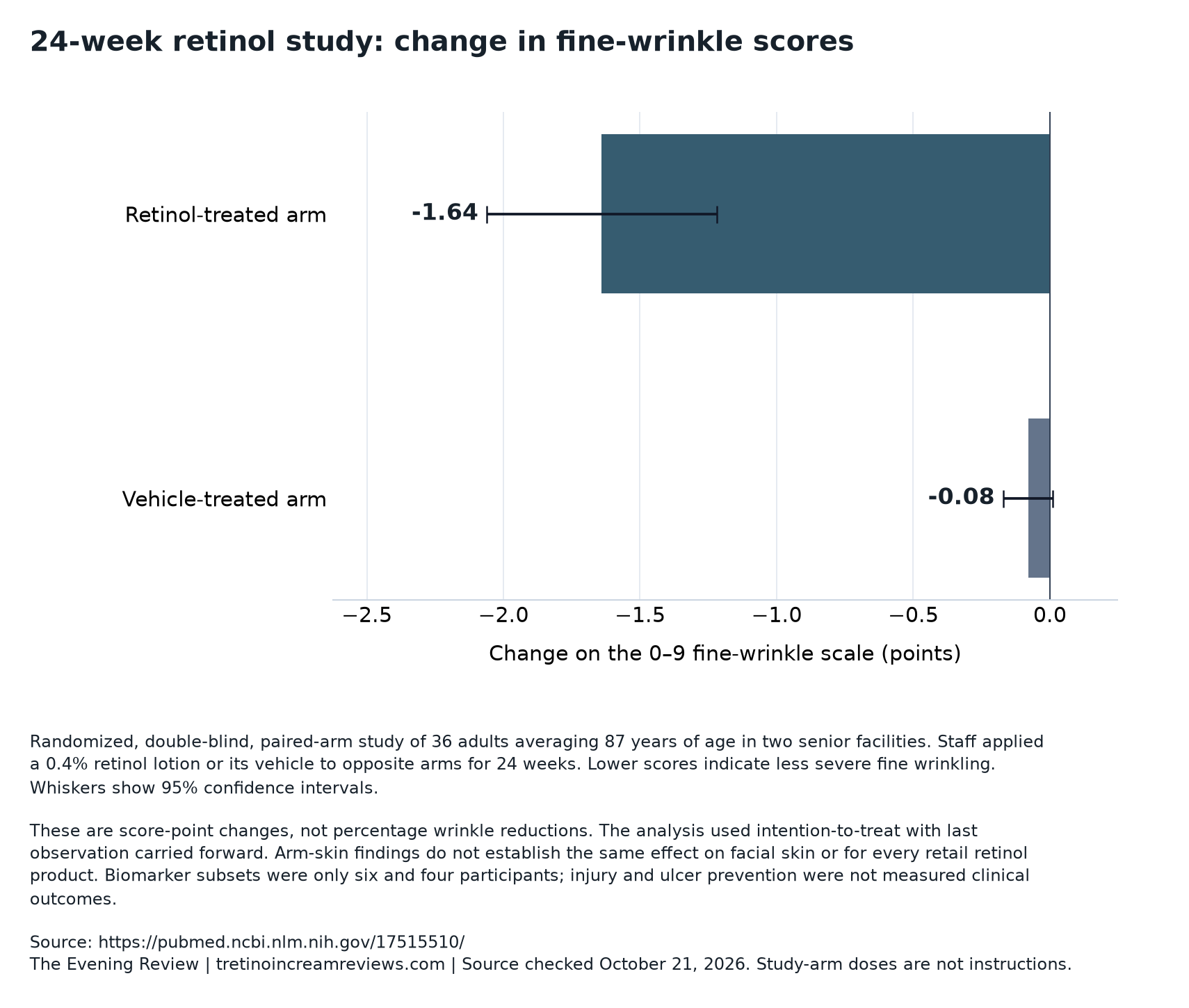
Fine-wrinkle result: Score changes were −1.64 with retinol and −0.08 with vehicle on a 0–9 scale; these are score points, not percentage reductions. Source 2
Biopsy evidence: Glycosaminoglycan findings involved six participants; procollagen I findings involved four, not the entire study population. Source 2
Unmeasured benefit: The report proposed greater resistance to injury and ulcer formation, but did not report a clinical ulcer-prevention outcome. Source 2
An unusually old population, with a specific skin question
The study asked whether retinol could improve signs of natural aging, rather than testing a broad claim about all forms of facial photodamage. Its 36 participants lived in two senior citizen facilities, and their mean age was 87. The academic referral-center study therefore contributes evidence in a population that cannot simply be represented by trials of younger adults with sun-damaged faces.
That age is a group average, not a statement that every participant was 87 or that the findings apply equally across all older ages. The indexed abstract does not provide an age range, detailed health profile, skin-type distribution, or enough eligibility information to establish how representative these residents were. Those omissions matter when interpreting results for older adults living independently or managing different skin conditions.
The measured site was arm skin. Facial appearance, facial tolerability, and daily cosmetic use were not the same experimental question. The practical value of this study is that it directly investigated very old skin; its limitation is that age alone does not make every other feature transferable. Our mature-skin consultation guide offers a separate framework for organizing those distinctions.
Read the underlying chart data: download CSV or download the source-labeled chart.
Why comparing opposite arms strengthens the finding
This was a randomized, double-blind, vehicle-controlled, within-person experiment. Each participant contributed a retinol-treated arm and a comparison arm. Randomization assigned treatment by side; blinding was intended to reduce the influence of knowing which treatment was being assessed. The abstract identifies the design but does not describe the allocation procedure or report whether blinding remained successful.
Using opposite arms helps hold constant many personal characteristics that would otherwise differ between treatment groups. The same resident supplies both observations, so age and many person-level influences are shared. The comparison is therefore not simply between people who chose retinol and people who did not. It still requires appropriate paired analysis because two arms from one person are not independent participants.
The vehicle is the lotion base without the active retinol. It provides a more informative comparator than an untreated photograph because the treatment experience includes the base as well as the active ingredient. A before-and-after image alone cannot separate those contributions or show what would have happened over the same period without retinol. That distinction is central to reading before-and-after reviews.
The treatment schedule describes an experiment, not a routine
Study personnel applied a topical lotion containing 0.4% retinol, or its vehicle, at visits up to three times a week for 24 weeks. These details identify the intervention actually tested. They do not establish a universal application schedule, the best concentration for a particular person, or the performance of other retinol products bearing the same percentage.
Staff application is scientifically relevant because it differs from unsupervised home use. It places delivery within a study process rather than relying entirely on participants to remember and reproduce applications. However, the abstract does not give the amount applied, the actual number of applications received, or a detailed account of interruptions. The words “up to” should not be silently converted into three applications every week for everyone.
Retinol is not tretinoin, also called retinoic acid. A percentage attached to one is not a potency conversion for the other. Nor does a lotion result automatically transfer to a serum, compounded preparation, or oral formulation. The cream-versus-serum guide helps frame formulation questions, but this trial itself supplies no head-to-head evidence comparing those formats.
Reading the wrinkle result without turning points into percentages
Clinical signs were assessed on a semiquantitative scale running from 0, meaning none, to 9, meaning most severe. Semiquantitative means that an observer assigns an ordered severity score rather than measuring a physical quantity such as wrinkle depth in millimeters. Lower scores indicated less severe wrinkling. The reported fine-wrinkle change was −1.64 with retinol, compared with −0.08 with vehicle.
Subtracting those reported changes gives a descriptive between-treatment contrast of 1.56 score points favoring retinol. It does not give a 64% reduction, a percentage of wrinkles removed, or a percentage of participants who improved. A percentage reduction would require an appropriate baseline denominator and a defensible interpretation of ratios on this rating scale. Neither follows from the reported change alone.
The confidence intervals describe uncertainty around each reported change. The abstract reports a treatment-comparison P value below .001, supporting a difference under the analysis used. It does not provide a confidence interval for the paired treatment contrast, which cannot be reconstructed reliably from the two intervals without additional information about their relationship.
What the 24-week fine-wrinkle numbers mean
| Reported measure | Result | Correct interpretation |
|---|---|---|
| Retinol score change | −1.64; 95% CI −2.06 to −1.22 | An average reduction in severity-score points, not a percentage reduction. |
| Vehicle score change | −0.08; 95% CI −0.17 to 0.01 | Little average change; the interval includes zero. |
| Treatment comparison | P < .001 | Evidence of a treatment difference, not a measure of its visual importance. |
| Difference calculated from reported changes | 1.56 points favoring retinol | Descriptive subtraction; a confidence interval for this paired contrast is not reported. |
Missing observations remain part of the result
The researchers described an intent-to-treat analysis using last observation carried forward. Intent-to-treat signals an effort to retain participants in the analysis according to their assigned treatment. Last observation carried forward is a method that substitutes an earlier available measurement when a later one is missing. It is not evidence that everyone completed all visits.
This matters because a reported 24-week estimate may include some values observed before week 24. Carrying them forward assumes, for the substituted measurement, that the earlier result adequately represents the later outcome. If improvement continued, irritation prompted withdrawal, or scores changed after missed visits, that assumption could affect the estimate. The direction of any resulting bias cannot be determined from the abstract.
The indexed report does not provide the completion count, reasons for missingness, timing of missing visits, or alternative analyses under different assumptions. Consequently, the strong statistical comparison should be read alongside incomplete information about follow-up. It would be equally mistaken to declare that attrition invalidated the trial or to claim there was no attrition merely because an intent-to-treat result was reported.
Biopsies suggest biology, not proven resistance to injury
The biopsy findings came from much smaller groups than the clinical study. Retinol increased glycosaminoglycan expression compared with vehicle in six participants, with P = .02. Glycosaminoglycans are components of the skin matrix associated with water retention. Procollagen I immunostaining increased in four participants, with P = .049. Immunostaining detects a tissue marker; procollagen is a precursor involved in collagen production.
These results support a biological explanation worth investigating, but neither P value supplies an effect size. The abstract does not report percentage increases, confidence intervals for the biopsy effects, or enough information to determine how well these small subgroups represented all 36 participants. Four biopsy observations cannot be presented as a collagen increase demonstrated throughout the full trial population.
The authors proposed that greater matrix synthesis might improve resistance to injury and ulcer formation. That is a hypothesis extending beyond the measured appearance and tissue markers. The report does not establish fewer skin tears, fewer ulcers, faster wound healing, or improved mechanical strength. A trial designed around those clinical events would be needed to test whether the proposed structural changes translate into functional protection.
What the available evidence says about treatment burden
The retinol abstract does not supply a complete adverse-event table, irritation counts, or discontinuations attributed to treatment. That prevents a numerical benefit–harm assessment for this particular lotion in these very old adults. It does not justify either a claim of zero irritation or an assumption that its adverse-effect frequency matched a different retinoid trial.
There is concrete irritation evidence in the separate 48-week tretinoin concentration study. Among 99 completers, 0.1% and 0.025% tretinoin produced similar reported clinical improvement, while redness and scaling were significantly greater with 0.1%. This shows why irritation should be treated as an outcome in its own right, not as a required visible sign that a product is working.
The current RENOVA 0.02% label supplies another product-specific example: almost all treated patients reported one or more local reactions, about 4% discontinued because of adverse reactions, and 32% had irritation meeting a combined description of severity, temporary discontinuation, or mild topical corticosteroid use. Those are tretinoin-cream findings, not retinol rates. The persistent-redness guide addresses questions that efficacy photographs leave unanswered.
Two tretinoin trials answer different questions
The 48-week concentration trial compared once-daily topical 0.1% tretinoin, 0.025% tretinoin, and vehicle in people with facial photoaging. Its abstract describes 99 completers, not necessarily the total initially enrolled. Both active concentrations improved overall facial photoaging compared with vehicle, with no clinically or statistically significant efficacy difference reported between them. That is not proof that all concentrations are equivalent in every setting.
A separate randomized two-year study treated 204 participants with moderate to severe facial photodamage using topical 0.05% tretinoin emollient cream or vehicle once daily. It reported greater improvement across several clinical signs and no increase in specified adverse histologic findings compared with vehicle. A procollagen marker increased at month 12 at three study centers. The abstract does not provide numerical clinical effect sizes or comprehensive symptom rates.
These trials extend the discussion of duration, facial outcomes, and irritation, but do not rank retinol against tretinoin. Drug, formulation, body site, population, and outcome definitions differ. The companion analysis of concentration and irritation examines the direct comparison within the 48-week trial, where treatment differences can be interpreted more credibly.
Three controlled studies with different targets
| Study | Population and comparison | What it adds |
|---|---|---|
| 24-week retinol study | 36 adults, mean age 87; opposite arms received 0.4% retinol lotion or vehicle. | Direct evidence for fine-wrinkle score improvement in naturally aged arm skin. |
| 48-week tretinoin concentration study | 99 facial-photoaging completers; 0.1%, 0.025%, or vehicle. | Similar reported efficacy at two concentrations, with greater irritation at 0.1%. |
| Two-year tretinoin study | 204 participants with moderate to severe facial photodamage; 0.05% emollient cream or vehicle. | Longer facial follow-up and specified clinical and histologic findings, not a retinol comparison. |
A current cream label does not inherit the retinol trial
RENOVA 0.02% has a narrowly stated indication: mitigation of fine facial wrinkles as an adjunct to comprehensive skin care and sunlight avoidance. Its current labeling does not promise wrinkle elimination or reversal of photoaging. The label also states that efficacy was not adequately demonstrated across the trials for several other signs, including coarse wrinkling and skin laxity.
Its age discussion is particularly important here. Participants aged 65 to 71 did not show a significant difference in fine-wrinkle improvement compared with those younger than 65; safety and effectiveness above age 71 have not been established for this product. The retinol study's mean age of 87 does not fill that gap because it tested a different active ingredient, formulation, and skin location.
Likewise, the label's limits on established daily use beyond 52 weeks are not erased by the two-year trial of 0.05% tretinoin emollient cream. Evidence belongs to the preparation and question studied. The label identifies Bausch Health as RENOVA's distributor; that commercial identity should not be mistaken for sponsorship information about the retinol trial, which the accessible abstract does not provide.
Translating the findings into an evidence audit
A useful claim audit starts with the endpoint. Fine-wrinkle severity, collagen-related staining, facial pigmentation, skin strength, and ulcer prevention are different outcomes. Next comes the comparator: improvement against a matched vehicle supports an active-treatment contribution more directly than improvement from baseline alone. Finally, the population and actual formulation determine how closely a commercial claim resembles the experiment.
Editorial interpretation: an impressive study citation is not enough to justify purchasing a long supply or accepting a recurring contract. The retinol trial did not measure costs, cancellation experiences, access to follow-up, or outcomes from online providers. Those questions require documentary review rather than borrowing credibility from the clinical result.
For that separate task, readers can check the documented offer and renewal details in the Nurx review or Dear Brightly review. These links invite examination of terms only; they do not establish that either provider supplies the studied lotion or reproduces its outcomes. Scientifically, the next valuable studies would connect appearance scores with patient-perceived benefit, adequately report irritation and missing data, and directly test any proposed protection against injury.
Questions about the evidence
Was the wrinkle reduction 64%?
No. The reported retinol change was −1.64 points on a severity scale from 0 to 9. It was not a percentage. The vehicle change was −0.08 points, giving a descriptive difference of 1.56 points. The abstract does not establish a percentage reduction in wrinkle number, depth, or visible area.
Does a mean age of 87 make this strong evidence for every older adult?
It makes the trial unusually relevant to very old skin, but not universally representative. Only 36 residents from two facilities participated, and the intervention was applied to arms by staff. The abstract lacks the demographic and health detail needed to judge transfer to all older adults or to facial use.
Did retinol prevent ulcers or make skin harder to tear?
Those clinical benefits were not demonstrated. The authors proposed improved injury resistance based on matrix-related findings, but the reported endpoints were clinical skin ratings and biopsy measurements. Establishing prevention would require measuring injuries or ulcers in an appropriately designed study, rather than treating tissue markers as substitutes for those events.
Can the tretinoin studies tell us which retinol concentration is equivalent?
No. They tested a different active ingredient and different formulations in facial photoaging. Neither the 48-week concentration comparison nor the two-year trial directly compared tretinoin with retinol. Their results cannot supply a conversion ratio or establish which treatment would work better in the elderly arm-skin population.
How much of the original research was available for this analysis?
This analysis uses the indexed primary-report abstracts for the three research studies and the available full official RENOVA labeling. It does not claim examination of all full articles, protocols, or supplements. Details absent from those accessible reports—including complete retinol safety counts and trial sponsorship—remain unresolved here.
Source 2 Source 1 Source 3 Source 4
What this evidence supports
The retinol trial provides credible randomized evidence that one staff-applied 0.4% lotion improved fine-wrinkle ratings in naturally aged arm skin over 24 weeks. Its within-person vehicle comparison is a substantial advantage over uncontrolled product photographs. Confidence is narrower for the magnitude of personally noticeable benefit, tolerability, durability, and transfer to other products or facial use. The biopsy observations strengthen biological plausibility but do not establish injury prevention. The appropriate conclusion is a formulation-specific appearance benefit with important unanswered clinical questions—not generalized rejuvenation or a ranking against tretinoin.
Research access and limitations
Research evidence was available as indexed original-report abstracts, alongside full current official RENOVA labeling. Complete retinol adverse-event counts, attrition details, baseline wrinkle scores, subgroup selection methods, and sponsor information were not available in those abstracts. No cross-trial efficacy conversion was attempted.